Localized contact can readily escalate into an interstate crisis.
Last updated:
THAILAND–CAMBODIA BORDER CONFLICT
Reading the border conflict through its structures
A cross-cutting account of history, international law, domestic politics,
and the military crisis as of July 2026.
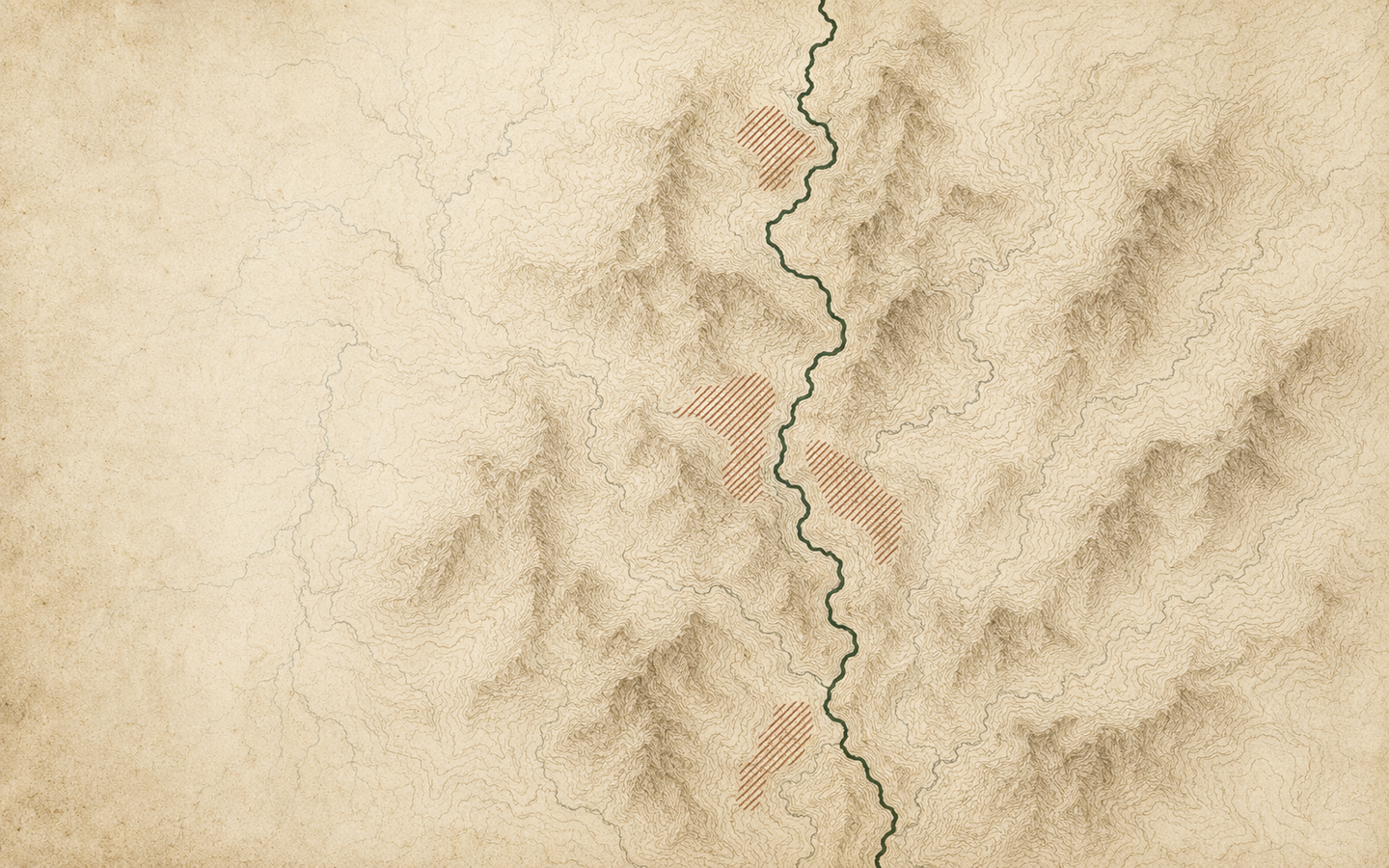
Border line Principal disputed areas
BORDER CORRIDORapprox. 817 km
01 / CURRENT SITUATION
The ceasefire holds. The crisis structure remains
Frameworks exist to contain large-scale fighting, while mutual accusations over troop deployments, mines, border management, and sovereignty continue to impede normalization.
Stalled movement of people and goods increases the burden on border regions.
Connecting bilateral mechanisms with ASEAN support remains central.
ANALYTICAL JUDGMENT
The central problem extends beyond demarcation itself: the ceasefire has not been converted into routine crisis management. Disagreement over facts on the front line, domestic narratives, and the preferred mode of negotiation reinforce one another.
FACT CHECK / 19 JUL 2026
Military clashes, casualties, ICJ decisions, and the scope of map depictions were re-audited. The cause of the 2026 explosion remains unverified.
Audit results →Update dates vary by page. See What's New for the latest update status.
Provisional assessment based solely on publicly available informationCambodian position ↗Post-ceasefire disputes ↗ASEAN 2026 ↗
CRISIS MECHANISM
Why has the ceasefire not produced normalization?
Divergent perceptions of patrols, mines, drones, and positions.
Incomplete information hardens into government and military claims.
Nationalism and civil–military relations narrow the space for compromise.
Closures and restrictions affect livelihoods, employment, and trade.
Socioeconomic losses reproduce grievances and hard-line positions.
Ceasefire ≠ normalization. Breaking the cycle requires simultaneous action at the front-line, operational, and political levels.
02 / HISTORICAL TIMELINE
More than a century of boundary politics
Maps, judicial decisions, nationalism, and front-line operations have accumulated on different timelines. It is essential to distinguish areas legally decided from those that still require negotiation.
Franco-Siamese treaties and maps
The relationship between the watershed-line principle and maps produced during the French Indochina period became a starting point for later disputes over interpretation.
ICJ judgment on the merits
The Court found that the Temple of Preah Vihear was situated in Cambodian territory and ordered Thailand, among other measures, to withdraw its forces.
Land-boundary MOU
The bilateral procedure for survey and demarcation was organized around the Joint Boundary Commission (JBC).
World Heritage inscription
The inscription repoliticized sovereignty around the temple and increased tensions along the front line.
Fighting and provisional measures
Intermittent clashes escalated into heavy-weapons combat in 2011. The ICJ established a Provisional Demilitarized Zone (PDZ).
ICJ interpretation judgment
The Court confirmed Cambodian sovereignty over the whole promontory on which the temple stands.
Renewed escalation
Localized clashes developed into a cycle of border closure, large-scale combat, displacement, ceasefires, and renewed fighting.
LEGAL LANDMARKS
The ICJ decisions established important legal standards for Preah Vihear / Phra Viharn and its surroundings, but did not complete the demarcation of the entire approximately 817-kilometre border.
2025–2026 / CRISIS LEDGER
From localized clashes to a frozen conflict
The ceasefire was not a single agreement, but a process of breakdown and renegotiation.
Exchange of fire in the border area
One Cambodian soldier was killed in a brief engagement. The two militaries presented different accounts, linking an event on the front line directly to politics in the capitals.
JBC reconvenes after thirteen years
Practical talks on survey and demarcation resumed, while differences over disputed locations and procedure remained.
Primary source / reporting ↗Leaked leaders’ call and border restrictions
The leaked diplomatic call unsettled Thailand’s civil–military and coalition relations, while restrictions on cross-border movement became linked to diplomatic pressure.
Primary source / reporting ↗Escalation to shelling, rockets, and air strikes
Heavy weapons were used across several fronts, causing many casualties and displacement on the scale of hundreds of thousands. Risks to cultural heritage also became an international concern.
Primary source / reporting ↗Immediate and unconditional ceasefire
The two prime ministers agreed to a ceasefire. Diplomatic engagement, including by regional institutions, supported negotiations and the formation of an implementation framework.
Primary source / reporting ↗GBC and RBC specify operating arrangements
National- and regional-level discussions continued on ceasefire monitoring, troop conduct, communications, and civilian protection.
Primary source / reporting ↗Kuala Lumpur Joint Declaration
The declaration set out a stabilization package that included the withdrawal of heavy weapons, demining, and ASEAN monitoring support.
Primary source / reporting ↗Renewed fighting and displacement
Distrust over ceasefire implementation again turned into large-scale combat. Casualties and displacement increased further, exposing the fragility of the ceasefire.
Third Special GBC ceasefire and fragile calm
No large-scale engagement between the two militaries has been confirmed in public records, while disputes remain over troop deployments, barriers, mines and unexploded ordnance, and civilian returns.
Primary source / reporting ↗03 / FIVE LAYERS
Five layers of the conflict
Resolving one layer alone does not stabilize the crisis as a whole.
01Demarcation and the legal forum
Where, by whom, and through which procedure should decisions be made?
+
Cambodia emphasizes international law and international adjudication, while Thailand emphasizes the existing bilateral boundary-demarcation framework. The substantive territorial dispute overlaps with disagreement over the procedure for resolving it.
02Ceasefire and front-line crisis management
Can an agreement be translated into daily operations?
+
A ceasefire document alone does not determine how patrols, position construction, drones, warning shots, or casualty evacuation will be handled. Communication between local commanders and procedures for fact-finding and identifying violations are required.
03Mines, unexploded ordnance, and civilian returns
Safety requirements conflict with demands for accountability.
+
A mine incident can rapidly raise military tensions. Joint investigation and humanitarian clearance can build confidence, while accusations over possible new emplacement make cooperation more difficult.
04Border closure and the regional economy
A means of pressure becomes a loss for border communities.
+
The closure or restriction of crossings interrupts trade, tourism, employment, and access to medical care. Security measures, responses to transnational crime, and diplomatic pressure have become intertwined, complicating the conditions for reopening.
05Domestic politics and the information space
Events on the front line can unsettle a government’s legitimacy.
+
Sovereignty disputes make compromise easy to portray as weakness. Relations among militaries, parties, and leaders, together with leaks, social-media imagery, and historical narratives, narrow the space for negotiation.
04 / INSTITUTIONAL ARCHITECTURE
Institutions exist. The connections are weak
The problem is not the absence of consultative mechanisms. Vertical links from front-line facts to technical talks, and from technical talks to political decisions, remain weak, as does the authority required to support implementation.
JBCLEGAL / TECHNICAL
Joint Boundary Commission (JBC)
Survey and demarcation
Addresses maps, joint surveys, boundary pillars, and implementation of the 2000 MOU.
GBCDEFENCE
General Border Committee (GBC)
Security policy
Provides a ministerial-level forum for broad arrangements on ceasefire implementation and troop operations.
RBCMILITARY REGION
Regional Border Committee (RBC)
Front-line operations
Handles local communications, incident management, and civilian protection between regional commanders.
JCTFIMPLEMENTATION
Joint Coordinating Task Force
Humanitarian demining
Connects joint responses to mines and unexploded ordnance with confidence-building and safety.
AOTREGIONAL
ASEAN Observer Team (AOT)
Monitoring and verification support
Supports transparency in ceasefire implementation and third-party fact-finding.
TRACK 2NON-GOVERNMENTAL
Unofficial expert dialogue
Developing options
An institutional category for organizing options that are difficult to address in official talks through a non-binding channel. It does not refer to a particular country or process.
Front-line facts→Technical assessment→Political authorization→Joint implementation
THREE OPERATIONAL LAYERS
Viewing crisis management through three layers
An analytical framework for assessing whether front-line contact, practical fact-finding, and political authorization are connected, rather than focusing only on the names of institutions.
Manage contact
Local communications, notification of patrols and activities, drone operations, casualty evacuation, and commander-level talks.
Share facts
Joint verification, humanitarian responses to mines and unexploded ordnance, civilian returns, and phased operation of crossings.
Authorize implementation
Domestic explanation of agreements, clarification of the roles of bilateral and regional mechanisms, and verification of implementation.
05 / ACTORS & INCENTIVES
One border, viewed through different politics
THAILAND
Dispersed authority and bilateral management
- Priority
- Maintaining sovereignty, border control, and existing bilateral mechanisms
- Structure
- Decision-making dispersed among the civilian government, military, parties, and coalition
- Constraints
- Civil–military relations, domestic opinion, political vulnerability, and hard-line positions
- Implication
- Coordination is critical to implementing central agreements consistently on the front line
SHARED
BORDERMutual distrust
BORDERMutual distrust
CAMBODIA
Centralized leadership and emphasis on international law
- Priority
- Territorial integrity, civilian returns, and international support
- Structure
- Centralized decision-making and communication organized around the leadership
- Constraints
- Government prestige, historical narratives, and economic and migration pressures
- Implication
- The challenge is to reconcile international-law claims with practical compromise
BORDER CLOSURE
Border closure is not a single policy
Military restrictions, diplomatic pressure, responses to transnational crime, and domestic signalling overlap, obscuring the conditions for reopening.
Contain accidental clashes
Movement restrictions can help manage the front line, while also creating unofficial routes and dividing established living areas.
Apply pressure on the other party
Trade, tourism, and labour movement become bargaining instruments, making their restoration a political decision.
Address transnational crime
Responses to scam compounds and similar activities become connected to conflict management, multiplying policy purposes.
Border communities bear the cost
Losses affecting markets, employment, health care, education, and family ties outlast decisions taken in the capitals.
Criteria for reopeningFewer security incidentsJoint verification proceduresPhased operation by crossingPriority for humanitarian and livelihood movement
06 / RESEARCH LIBRARY
Reading competing claims through 195 sources
Sources close to governments or militaries can be evidence of events and objects of narrative analysis at the same time. Original documents, third-party research, and sources from the other party are compared.
195Total records
104Priority A
88Direct PDF links
37Thai / Khmer
Suggested reading order① Foundational history & maps→② ICJ & treaties→③ Domestic politics→④ 2025–26 primary sources
Cambodia–Thailand Boundary
US Department of State, IBS No. 40 (1966): a basic source on treaties, maps, and the boundary.
Open source ↗ICJ 1962 Judgment
The judgment on the merits in the Temple of Preah Vihear case, used to confirm the precise scope of the decision in the original text.
Open source ↗ICJ 2013 Interpretation
The interpretation judgment clarifying the meaning of the 1962 judgment and its application to the surrounding area.
Open source ↗MOU 2000 / MOU 43
The foundational document for the bilateral framework to conduct joint survey and demarcation of the land boundary.
Open source ↗Waging Peace
An International Crisis Group report examining the 2011 crisis and ASEAN involvement.
Open source ↗ASEAN’s Unwanted Conflict
A 2026 expert roundtable spanning history, domestic politics, military affairs, and regional order.
Open source ↗タイ 2025年の政治・経済 [in Japanese]
An IDE-JETRO yearbook tracing the government, civil–military relations, and the border crisis.
Open source ↗カンボジア 2025年の政治・経済 [in Japanese]
An IDE-JETRO yearbook examining the domestic political and socioeconomic effects of the crisis.
Open source ↗PRIMARY DOCUMENT TRAIL
Joint announcement on the immediate ceasefireSpecial GBC Joint Press StatementSpecial RBC Joint Press ReleaseKuala Lumpur Joint DeclarationThird Special GBC ceasefireTrack ceasefire implementation through primary sources
Breakdown: history 28; international law 51; bilateral relations and domestic politics 51; military and security 17; other 48. The research scope includes Preah Vihear / Phra Viharn, Ta Muen Thom / Ta Moan Thom, Ta Kwai / Ta Krabei, Mom Bei / Chong Bok, the JBC, GBC, and RBC, and the 2025 fighting.